
Choosing a carbon registry is one of the first strategic decisions a project developer or corporate sustainability team makes. It affects how your project is assessed, which buyers can understand its value, and how confidently you can stand behind every credit.
The two names most teams compare are Verra’s Verified Carbon Standard (VCS) and Gold Standard. Both provide credible frameworks for quantifying and verifying emissions reductions, but they serve different project shapes and buyer expectations.
Understanding the two certification leaders
Verra’s VCS is known for scale, broad methodology coverage, and liquidity. It is often a practical fit for large nature-based, renewable energy, waste, and industrial decarbonisation projects.
Gold Standard is known for its focus on sustainable development co-benefits. Its framework gives more weight to measurable contributions to the UN Sustainable Development Goals, which can matter to buyers with ambitious ESG reporting requirements.
Verra or Gold Standard: start with fit, not reputation.
The right choice depends on your project type, target buyers, selection criteria, and appetite for deeper impact verification.
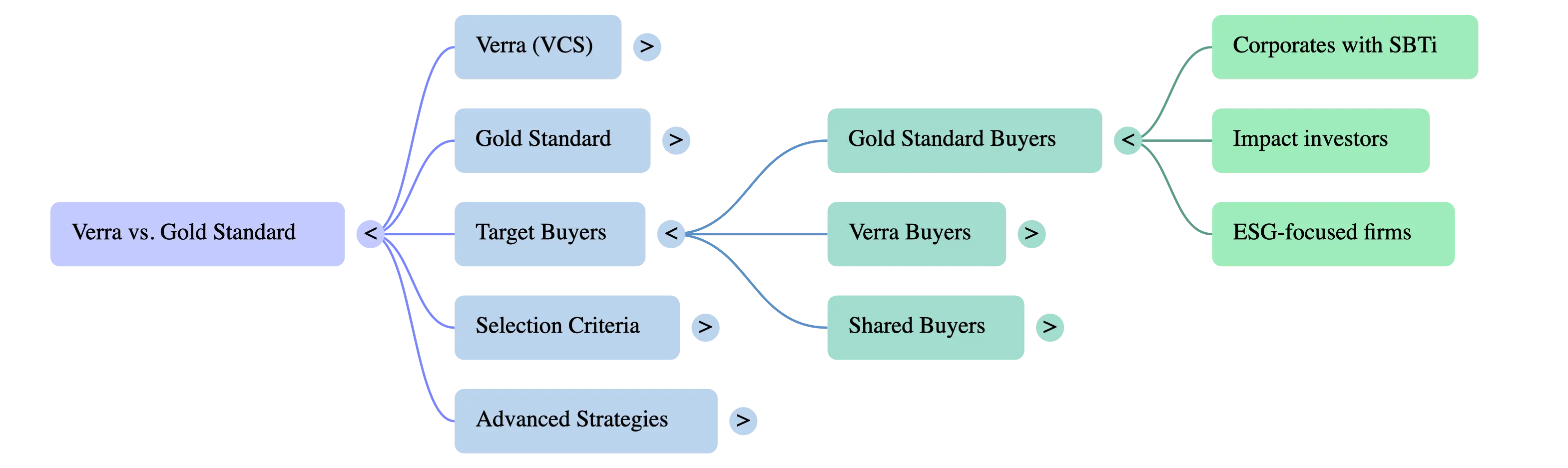
A registry decision connects project design to buyer expectations.
Choosing based on your project type
Verra supports a wide range of methodologies across agriculture, forestry, land use, renewable energy, methane avoidance, and blue carbon. That breadth makes it attractive when your project is large, technically complex, or built around a methodology with a mature validation ecosystem.
Gold Standard is especially compelling for community-centred projects where health, livelihoods, gender outcomes, or access to clean energy are central to the impact story. Clean cookstoves, safe water projects, solar home systems, and smallholder interventions can benefit from its structured co-benefits approach.
Know your buyers before you choose
Your buyer profile should influence the registry conversation from the beginning. A buyer seeking volume and broad market liquidity may value the reach of VCS. An ESG-led corporate, impact investor, or development finance institution may place a higher premium on independently documented social and environmental outcomes.
Science-based corporate buyers often want a clear, defensible sustainability narrative.
Consumer-facing offset platforms may prioritise volume, liquidity, and accessible pricing.
Impact investors tend to value rigorous social and biodiversity metrics.
Airline and compliance-related buyers require an additional eligibility review beyond the registry name.
Cost, timeline, and administrative considerations
Certification is an ongoing monitoring, reporting, and verification process, not a one-time badge. The right budget includes methodology work, validation, verification, monitoring systems, stakeholder engagement, and the internal time required to keep evidence current.
Verra can be more cost-efficient for large projects because established methodologies and a broad validator network can reduce bespoke work. Gold Standard may require more documentation around stakeholder consultation and co-benefits, but that additional rigour can strengthen the project’s premium positioning.
Can a project use both?
Dual certification can combine VCS market liquidity with a deeper social or biodiversity narrative. It can be powerful for the right multi-year project, but it also increases cost, documentation, and administrative complexity. Treat it as an investment case to model rather than an automatic upgrade.
The integrity question
Both registries operate in a market receiving closer scrutiny from buyers, journalists, regulators, and civil society. Registry selection is therefore also a reputational decision. Choose a framework that supports transparent baselines, defensible additionality, strong monitoring, and claims your organisation can stand behind.
The practical recommendation
There is no universal winner. Large-scale nature-based projects seeking broad market access may find Verra pragmatic. Community-impact projects targeting ESG-conscious buyers may benefit from Gold Standard’s emphasis on measurable co-benefits. The best registry is the one that fits your project context and your buyer promise.
What Is an ESG Score and How Is It Calculated?
A practical introduction to the environmental, social, and governance signals that shape how organisations are evaluated.
Need help choosing a registry?
Sustaind helps project developers and sustainability teams move from early-stage questions to a clear, defensible project pathway.
Contact Sustaind