


Setting Up a Global Capability Center in India: What You Need to Know in 2026By BNC Global | May 2026 | 7 min read
- summit49
- 1 day ago
- 7 min read

India's GCC story is no longer about cost savings. It never really was — not at its core. Today, more than 1,800 Global Capability Centers operate across the country, employing close to two million professionals and generating over $64 billion in annual revenue. The goal now is capability, ownership, and innovation at scale.
Still, a striking number of these centers underperform. Not because India lacks talent, but because the setup lacked clarity. The companies that succeed treat GCC setup as a strategic exercise. Those that struggle treat it as a procurement decision.
Here is what you actually need to know before you start.

What a GCC Is — and Why It Matters
A Global Capability Center is a wholly owned subsidiary of a multinational company, set up specifically to deliver strategic functions such as engineering, analytics, AI, finance, and digital operations. Unlike outsourcing, a GCC means the intellectual property stays with you, the culture is yours to build, and the people are aligned to your mission.
The distinction from a BPO or third-party arrangement is critical. With a GCC, you control what gets built and how it gets built. That ownership changes everything about how the center performs over time.
Choosing the Right Operating Model
There is no single correct model for setting up a GCC. The right choice depends on your timeline, risk appetite, and how much you know about India's talent market going in.
Wholly Owned Subsidiary (WOS) gives you full control from day one and is the preferred route for companies where IP protection and stock-option programs matter. The tradeoff is a slightly longer setup timeline.
Employer of Record (EOR) lets you hire and deploy people in India within two to three weeks through a local partner who employs them on your behalf. It is ideal for piloting before committing fully.
Build-Operate - Transfer (BOT) is a proven middle path: a partner builds and runs the center for the first 12 to 18 months, then hands it over to you. It combines local expertise with long-term ownership.
Managed or Nano GCC formats are growing fast among mid-market technology companies that want to operate with 50 to 150 people without building full internal infrastructure from scratch.
The most effective approach for companies without an existing India presence in 2026 is a phased entry: EOR for the first six months to validate talent and delivery models, followed by a BOT structure, with a full captive entity taking shape between 18 and 36 months.

Picking Your City
Location shapes your talent pool, operating costs, and long-term hiring competitiveness. The right city is not the most popular one — it is the one that best matches the functions you are building.
Bengaluru remains the largest GCC hub, accounting for roughly 35 to 39 percent of all activity. It offers deep engineering and AI talent but comes with a highly competitive market and a real compensation premium.
Hyderabad has emerged as a strong alternative, particularly for BFSI, analytics, and life sciences. Government support and slightly lower operating costs make it attractive for companies building mid-to-large centers.
Pune is the natural choice for engineering R&D and automotive technology. European and Japanese companies have found a strong cultural fit here.
NCR (Gurgaon and Noida) works well for companies with BFSI, consulting, or operations mandates and often serves as the right base for leadership hiring.
Chennai offers lower attrition than most metros, a mature IT ecosystem, and strong manufacturing and financial services infrastructure.
Tier-II cities including Coimbatore, Jaipur, and Nagpur offer 10 to 35 percent lower operating costs and are specifically being promoted under India's new National Framework for GCCs. They are worth serious consideration for shared services and operations functions.
The key rule: evaluate your function first, then your location. Not the other way around.

The Setup Process: What to Expect
A well-planned GCC takes 12 to 24 weeks from planning to go-live. The difference between the shorter and longer end of that range comes down almost entirely to how clear your mandate was before you started and how early you engaged legal and HR expertise.
Weeks 1 to 3 should be devoted entirely to defining the mandate. What business outcomes must this center deliver at 12, 24, and 36 months? What functions will it own? What does success look like? Without this clarity, every subsequent decision is harder than it needs to be.
Weeks 2 to 5 involve selecting the operating model and conducting city-specific talent market analysis. Do not rely on general comparisons; get a ground-level view of the talent landscape for your specific functions.
Weeks 4 to 10 cover entity registration (for a WOS, this means SPICe+ filing with the Ministry of Corporate Affairs), FEMA and RBI declarations for foreign investment, and registration under EPF, ESI, and the state-level Shops and Establishments Act.
Weeks 6 to 14 are often the most important: hiring the GCC Head. This is the decision that determines how everything else plays out. The right leader operates comfortably between your global headquarters and India's talent market, and has genuine decision-making authority. The hiring process for a strong candidate typically takes eight to twelve weeks. Do not compress it.
Weeks 8 to 16 involve workspace setup (most companies in 2026 start with flexible co-working to preserve headcount flexibility) and establishing cloud-first, Zero Trust infrastructure that connects the GCC to global workflows in real time.
Weeks 10 to 20 focus on structured talent acquisition, starting with functional leads and scaling out from there.
Weeks 16 to 24 are about governance: setting up reporting lines, measurable KPIs, and direct alignment with global CIO or CPO leadership. GCCs that report directly to global technology or product leadership consistently outperform those that sit further down the organizational chart.

Compliance: Do Not Cut Corners
India's regulatory environment has genuinely improved, and the 2026 Union Budget introduced a single-window approval portal and a standardized 15.5 percent safe harbour margin for transfer pricing that now covers over a thousand existing GCCs.
These are meaningful improvements.
But compliance still requires active attention. A Private Limited Company under the Companies Act 2013 is the standard entity structure. India allows 100 percent FDI under the automatic route for IT services with no prior government approval needed. EPF and ESI obligations apply to every employee. The Digital Personal Data Protection Act (DPDPA) is now in force and applies to any GCC handling data on Indian citizens.
Get a qualified local legal advisor involved in week one. Not month six.

Talent: What Indian Professionals Actually Want
India produces 1.5 million STEM graduates each year, and the senior talent pool in technology, analytics, and finance is deep. But you will be competing with Google, JPMorgan, and hundreds of other established GCCs for the best of it.
What experienced Indian professionals evaluate when considering a new GCC:
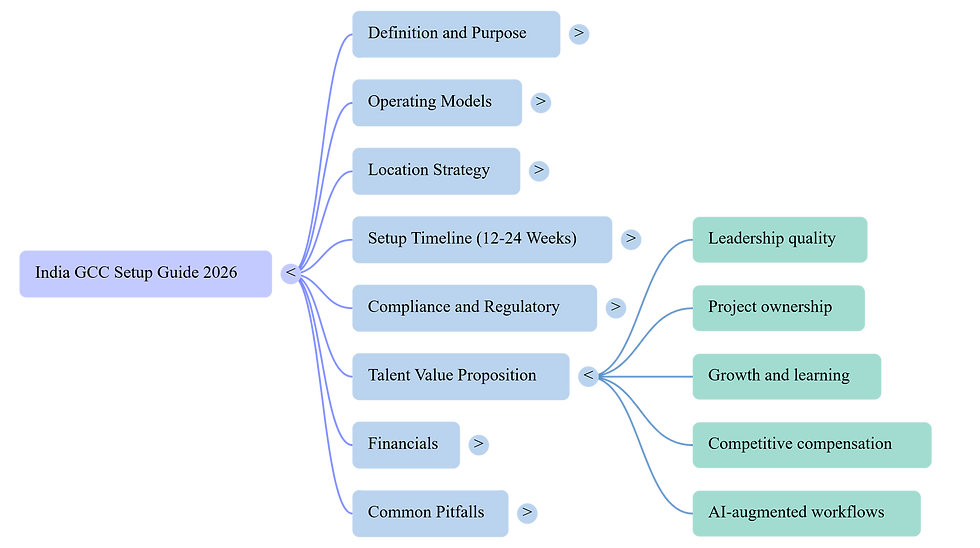
Leadership quality comes first. A credible GCC Head with real authority and a visible connection to global leadership is the single strongest signal that a center is worth joining.
Ownership is second. Top talent in India wants to build and own things — products, platforms, decisions. Centers structured around execution support for a team elsewhere will lose their best people within 18 months.
Learning and growth come third. Global exposure, technically interesting problems, and a clear career trajectory matter as much as the role itself.
Compensation is fourth— but must be competitive. Benchmark against global peers, not Indian IT service companies. Equity and stock options are increasingly expected at senior levels.
One shift that is genuinely new in 2026: more than half of GCCs are now deploying autonomous AI systems for complex reasoning tasks. The best talent being hired today understands how to design workflows where human judgment and AI work together. If your job descriptions have not evolved to reflect this, you are likely attracting yesterday's skill set.
What It Will Cost
Entity registration is relatively inexpensive — typically three to eight lakh rupees as a one-time cost. The significant costs are people and real estate.
Mid-level software engineers cost roughly 18 to 30 lakh rupees CTC annually depending on domain and location. GCC leadership (the Head role) typically ranges from 80 lakh to over two crore rupees depending on scope. Office space in Bengaluru or Hyderabad runs 12,000 to 25,000 rupees per seat per month. Employer contributions to EPF and ESI add approximately 15 to 20 percent on top of stated salaries.
Overall, most companies achieve 25 to 40 percent cost savings compared to equivalent operations in Western markets, though this figure varies significantly by function and seniority mix.
The most underestimated cost is leadership bandwidth. GCCs that underperform almost always share one characteristic: headquarters treated them as a project to hand off rather than a strategic asset to cultivate. Senior global involvement is not optional during the first 18 to 24 months.

The Mistakes That Derail GCCs
Starting with headcount targets instead of outcomes. Hiring 50 engineers by a deadline is not a strategy. Defining what those engineers will build, own, and deliver — that is.
Hiring the wrong first leader. A coordinator with no real mandate will lose your best Indian talent within 18 months. Hire someone with genuine authority and give them the space to use it.
Treating compliance as a later problem. Transfer pricing documentation, FEMA filings, data protection obligations — these create compounding liabilities when deferred. Address them from day one.
Designing for the old GCC model. Centers structured around task execution for a team elsewhere no longer attract or retain the caliber of talent that makes a GCC worthwhile. Design around what you want people to contribute, not what is convenient for headquarters.

The Bottom Line
India in 2026 is not just a cost play. It is a strategic opportunity to build genuine capability at scale, access one of the world's deepest engineering talent pools, and put your company closer to a growing share of global innovation.
The companies that will look back on this period as a turning point are the ones who invested the time to define a clear mandate, hired the right leader to execute it, and treated their India center as a core part of the business — not an offshore extension of it.
BNC Global provides end-to-end advisory support for GCC setup across India and Southeast Asia — from mandate definition and city selection to leadership hiring and compliance. Visit bncglobal.in to start a conversation.


Comments