


What is a Virtual CFO and When Does a Startup in India Need One?
- summit49
- 4 days ago
- 5 min read

Let's be honest — most startup founders in India didn't start their company because they love reading balance sheets.
You started because you had a product to build, a market gap to fill, or a problem that wouldn't leave you alone. Finance was always something you'd figure out later.
And then 'later' arrives. Suddenly you're staring at a cash flow statement you don't fully understand, trying to explain your burn rate to an investor, or scrambling to file GST returns before a deadline. You're making pricing decisions based on gut instinct, not numbers. Sound familiar?
This is exactly where a Virtual CFO steps in. And if you're a growing startup in India, chances are you need one sooner than you think.

So, What Exactly is a Virtual CFO?
A Virtual CFO (Chief Financial Officer) is a senior finance professional who works with your company on a part-time or fractional basis — giving you the strategic financial thinking of an experienced CFO without the cost of a full-time hire.
Think of it this way: a full-time CFO at a mid-sized Indian company earns anywhere between ₹30 lakh to ₹1.5 crore per year. For an early-stage startup, that salary alone could wipe out months of runway. A Virtual CFO gives you the same expertise at a fraction of that cost — typically ₹30,000 to ₹1,50,000 per month depending on scope.
You get access to someone who has probably already solved the exact financial problems you're facing right now — and knows what's coming next.

What Does a Virtual CFO Actually Do?
This surprises most founders. A Virtual CFO isn't just your accountant wearing a fancier title. The role is fundamentally strategic — they use your financial data to help you make better business decisions.
Here's what they typically handle:
• Financial Planning and Forecasting — building 12-month and 3-year models that actually reflect your business reality
• Cash Flow Management — making sure you never run out of money before your next milestone
• Fundraising Support — preparing investor-ready financials, due diligence packages, and valuation models
• Compliance Oversight — GST, TDS, ROC filings, advance tax — handled correctly and on time
• MIS Reporting — monthly dashboards that tell you exactly where the money is going and why
• Investor and Board Reporting — quarterly updates that keep your stakeholders confident
• Cost Optimisation — finding leaks in your P&L before they become full-blown crises
• Banking and Debt Structuring — negotiating working capital lines, managing lender relationships
Notice that most of this list is about the future, not the past. A good CA looks backward and records what happened. A Virtual CFO looks forward and helps you decide what to do next. Both are necessary — and they work best together.

A Virtual CFO vs. Your CA: What's the Difference?
This is the most common point of confusion, so let's clear it up.
Your Chartered Accountant files your taxes, handles statutory compliance, and ensures your books are in order. That's essential work. A Virtual CFO takes that same financial data and uses it to drive strategy — pricing decisions, hiring plans, fundraising timelines, market expansion.
One role is compliance-focused. The other is decision-focused. You need both, and confusing the two is one of the most expensive mistakes a startup can make.
When Does a Startup in India Actually Need a Virtual CFO?
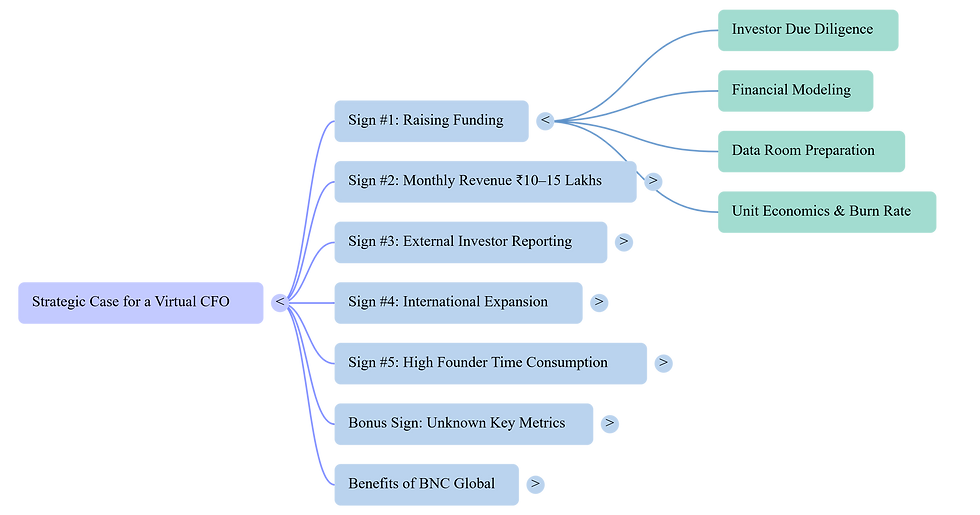
There's no single trigger point, but here are the signals that strongly indicate it's time:
1. You're raising your first or second round of funding. Investors expect clean books, a working financial model, and someone who can answer hard questions about unit economics. If you don't have that, you will lose deals — not because your product isn't good, but because you can't defend your numbers.
2. Your monthly revenue has crossed ₹10–15 lakhs. At this scale, financial decisions start having real consequences. A wrong call on pricing, vendor payment terms, or hiring can genuinely hurt.
3. You have more than 10 employees. Payroll, PF, ESIC, TDS on salaries — the compliance load multiplies quickly once you cross this threshold.
4. You're expanding into a new market or country. International business involves transfer pricing documentation, FEMA compliance, foreign currency accounting, and tax treaties. This is specialist territory.
5. You've received investor funding. Post-funding, your investors expect monthly MIS reports and clear financial accountability. This is not the time to be managing finances in a spreadsheet.
6. You're spending more than 10 hours a month on finance. If that's you, you are wasting founder time that should be on product and customers.
Quick test: How many months of runway does your company have right now? If you can't answer that within 30 seconds, you need a Virtual CFO immediately. Runway visibility is the most basic financial metric for any startup.
The India-Specific Context
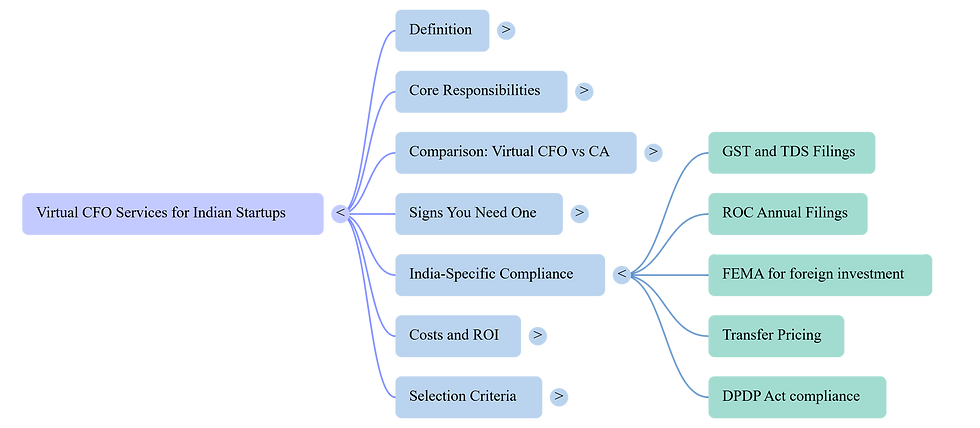
Running finance for an Indian startup isn't just about global best practices — it involves navigating a uniquely dense regulatory environment. A good Virtual CFO keeps you on the right side of all of this:
• GST filings — GSTR-1, GSTR-3B, annual returns, input credit reconciliation
• TDS deductions and quarterly returns (26Q, 24Q)
• ROC annual filings — AOC-4 and MGT-7
• FEMA compliance for any foreign investor or international customer
• Transfer pricing documentation for related-party cross-border transactions
• DPDP Act compliance requirements for companies handling personal data
Miss any of these deadlines and you're looking at penalties, interest, and sometimes notices from the Income Tax department. A Virtual CFO ensures this never happens quietly in the background.

What Does It Cost — and Is It Worth It?
For early-stage startups (pre-Series A), a Virtual CFO engagement typically costs ₹30,000–₹75,000 per month. For growth-stage companies, it might go up to ₹1–1.5 lakh per month for deeper involvement.
Now compare that against the cost of what goes wrong without one:
• A missed GST or TDS deadline: ₹10,000+ in penalties, plus interest
• A failed fundraise due to messy books: potentially crores in lost capital
• One bad cash flow decision that forces emergency layoffs: priceless in damage
• A transfer pricing notice from the Income Tax department: crores in potential adjustments
The ROI calculation almost always comes out clearly positive. The question isn't whether you can afford a Virtual CFO — it's whether you can afford not to have one.
How to Choose the Right Virtual CFO for Your Startup
Not all Virtual CFO services are equal. Here's what to look for:
• A dedicated senior professional on your account — not a junior analyst producing reports
• Proactive advice, not just reactive compliance — you want someone who flags problems before they happen
• Deep knowledge of Indian regulations — GST, TDS, ROC, FEMA, all of it
• Experience with companies at your stage and in your industry
• Availability for investor calls and board meetings when you need them
• Clear references from companies similar to yours
Ask these questions before signing any engagement letter. The answers will tell you a lot.
The Bottom Line
A Virtual CFO is not a luxury for well-funded startups. It's a practical tool for any founder who wants to scale without financial surprises — and who wants to spend their time building the company, not managing spreadsheets.
If you're at the stage where financial decisions are starting to matter — and for most startups, that's earlier than founders expect — a Virtual CFO is one of the best investments you can make.
BNC Global provides Virtual CFO services to startups and SMEs across India, UAE, Saudi Arabia, and Australia. If you're unsure whether you need one, we offer a free 30-minute consultation to assess your situation — honestly, with no sales pressure.
Related blogs you should read next:
→ Top 5 Signs Your Startup is Ready to Hire a Virtual CFO
→ Virtual CFO vs Full-Time CFO: Which is Right for Your Indian Startup?
→ How Much Does a Virtual CFO Cost in India? (2026 Pricing Guide)


Comments