


Top 5 Signs Your Startup is Ready to Hire a Virtual CFO
- summit49
- 4 days ago
- 5 min read

Most startup founders wait too long before bringing in senior financial expertise.
The pattern is predictable: you hire a bookkeeper early on, rely on your CA for compliance, manage everything else in a spreadsheet, and tell yourself you'll get proper finance systems in place 'once things stabilise.' The problem is, in a startup, things rarely stabilise on their own. They either scale — or they break.
By the time something breaks — a failed fundraise, a cash flow crisis, a surprise tax notice, an investor losing confidence — the damage is already done and the cost of fixing it is far higher than the cost of preventing it.
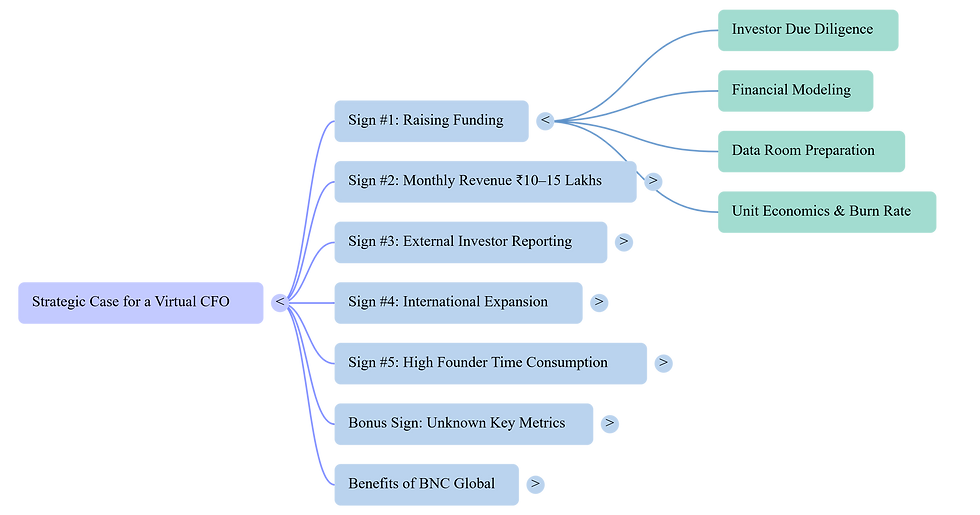
Recognising the warning signs early is what separates startups that scale cleanly from those that stumble over their own finances. Here are the five clearest signals that it's time to bring in a Virtual CFO.
Sign 1: You're Preparing to Raise Funding
Investor due diligence is thorough and unforgiving. Serious investors — whether angels, seed funds, or institutional VCs — will ask for audited financials, a detailed financial model, unit economics breakdown, cap table, and clear answers about your burn rate, runway, and path to profitability.
If your books aren't clean, if your projections aren't defensible, or if you stumble on basic questions about your gross margin or customer acquisition cost, you will lose deals. Not because your product isn't good — because investors can't trust your numbers, and they can't back a founder who doesn't know their own financials.
A Virtual CFO prepares you for this systematically. They clean up your historical financials, build a credible and stress-tested model, prepare your data room, and make sure you walk into every investor meeting with complete confidence. Many of our clients at BNC Global have told us that having a Virtual CFO present during due diligence was the single factor that moved a deal from 'maybe' to 'yes.'
If you have investor meetings coming up in the next 60–90 days and your books aren't clean, start the Virtual CFO conversation now — not the week before.
Sign 2: Your Monthly Revenue Has Crossed ₹10–15 Lakhs
Below this threshold, you can manage finances reasonably well with a good bookkeeper and a CA. Above it, the complexity multiplies fast — and the stakes of getting it wrong rise significantly.
At ₹10–15 lakhs per month in revenue, you're likely dealing with multiple clients on different payment terms, GST input credit reconciliation, TDS deductions across multiple vendors and employees, payroll for a growing team, and the beginning of real working capital pressure.
More importantly, you're now at a stage where financial decisions — your pricing structure, your payment terms with clients, your vendor contracts, your hiring pace — have material impact on whether you survive and grow. These decisions need someone who can model the financial consequences, not just record them afterward.
This is the inflection point where a bookkeeper's skill set ends and a CFO's begins.

Sign 3: You Have Investors or a Board You Report To
The moment you have external investors — even one angel who put in ₹25 lakhs — you have reporting obligations. Monthly MIS, quarterly updates, annual board meetings, and ad-hoc queries from your cap table. All of these require accurate, timely, and well-presented financial information.
Investors who aren't getting good financial visibility get nervous. Nervous investors make uncomfortable demands — more frequent calls, tighter controls, questions about every expense. A Virtual CFO manages this relationship professionally and preemptively, producing the reports that keep your stakeholders informed and confident.
There's also a more subtle benefit: when investors see that you have senior financial oversight in place, it signals maturity. It tells them that you take the business seriously and that their money is being managed responsibly. That credibility compounds over time, especially when you come back for your next round.

Board members and investors notice the quality of the financial reporting they receive. A well-structured MIS with clear commentary is a trust-builder. A messy spreadsheet sent two weeks late is a trust-destroyer.
Sign 4: You're Expanding Beyond India
The India-UAE corridor, India-Saudi Arabia, India-Australia, India-US — cross-border business introduces a completely different layer of financial complexity that most generalist CAs aren't equipped to handle efficiently.
Here's what suddenly comes into play the moment you start doing business internationally:
• Transfer pricing documentation — if your Indian entity is transacting with a related entity abroad, Indian tax law requires arm's length pricing and an annual TP study. Getting this wrong can result in crore-level adjustments.
• FEMA compliance — every foreign currency transaction involving an Indian entity is regulated. Receiving international payments, remitting dividends, setting up a subsidiary abroad — all require specific documentation, some requiring RBI approval.
• Double Taxation Avoidance Agreements (DTAA) — understanding how to structure transactions to avoid being taxed twice on the same income.
• Foreign subsidiary accounting — consolidating financials across currencies, intercompany eliminations, foreign exchange gain/loss treatment.
• VAT/GST in foreign jurisdictions — especially relevant for UAE (5% VAT) and other GCC countries.
BNC Global specialises in exactly this — helping Indian companies manage the financial complexity of cross-border operations, particularly across the India-UAE and India-Saudi corridor. If you're expanding internationally without specialist finance support, you're taking on significant risk.

Sign 5: Finance is Consuming More Than 10 Hours of Your Week
This one is simple arithmetic.
If you, as a founder or CEO, are spending 10 or more hours per week on finance — reviewing bills, chasing client payments, handling bank queries, trying to reconcile your accounts, attempting to understand why your P&L doesn't match your bank balance — you are burning your most valuable resource.
Your time as a founder is best spent on product, customers, partnerships, and building your team. Every hour you spend on finance is an hour not spent on the things that actually grow your company.
A Virtual CFO costs ₹30,000–₹75,000 per month. If you're a founder spending 10 hours a week on finance, the opportunity cost of that time — in deals not closed, products not built, talent not hired — almost certainly exceeds that amount. The math makes itself.

Ask yourself right now: Do I know my runway to the nearest month? Do I know my gross margin off the top of my head? Do I know which of my customers is most profitable? If any of these answers is 'not really' — that's the sign.
The Bonus Sign: You Don't Know Your Numbers
We'll add one more, because it's the most honest indicator of all.
If someone asked you right now — 'What's your runway?', 'What's your burn rate?', 'What's your gross margin?' — and you couldn't answer confidently within 30 seconds, you need a Virtual CFO.
These aren't advanced metrics. They're the absolute baseline of financial awareness for any startup founder. Not knowing them doesn't make you a bad founder — it makes you an underserved one. A Virtual CFO fixes this fast.
What to Do Next
If two or more of these signs apply to your company, the conversation is overdue. The good news is that a Virtual CFO engagement can be set up quickly — within a week or two — and the impact on your financial clarity is almost immediate.
You don't need to have everything figured out before you reach out. In fact, the messier your financial situation, the more value a Virtual CFO can add in the first 90 days.

BNC Global offers a free 30-minute financial health check for startups — no obligation, just an honest conversation about where you are and what you actually need. We serve companies across India, UAE, Saudi Arabia, and Australia.
Related blogs you should read next:
→ What is a Virtual CFO and When Does a Startup in India Need One?
→ Virtual CFO vs Full-Time CFO: Which is Right for Your Indian Startup?
→ How Much Does a Virtual CFO Cost in India? (2026 Pricing Guide)


Comments